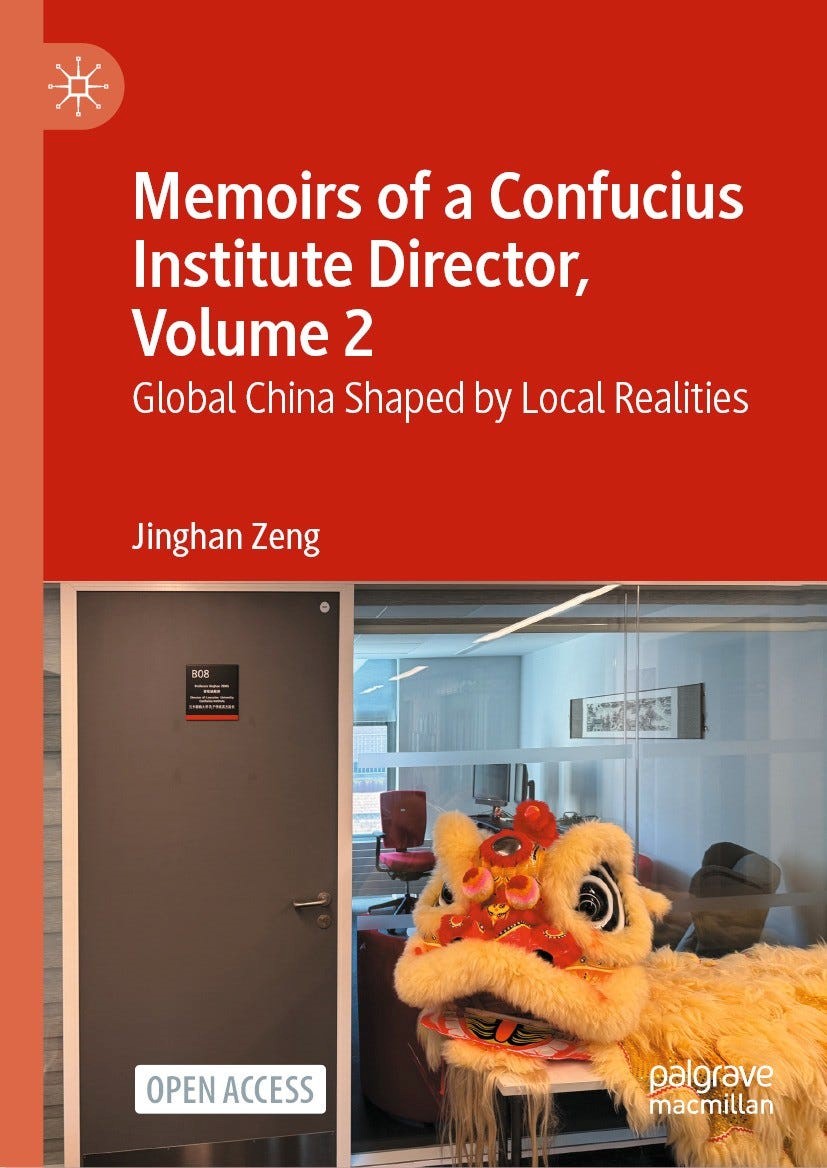
Michael Jinghan Zeng: Inside a Confucius Institute
The following excerpt focuses on the people who actually keep Confucius Institutes running.
Western political and media narratives sometimes portray Confucius Institute staff as politically vigilant operatives carrying out Beijing’s agenda abroad. Zeng’s account of Lancaster University offers a rather different — and considerably more mundane — picture: British administrators who may know little about China when they take the job; Mandarin teachers recruited from very different professional backgrounds; constant staff turnover; arguments over teaching hours; visa paperwork, budgets, event flyers, farewell cards, and the occasional accidental map of China without Taiwan.
Traversing the Belt and Road — Harvard University Press
Heine says: "I arrived in Beijing as Chile's ambassador to China in July 2014, mere months after President Xi Jinping launched the Belt and Road Initiative (BRI), China's most ambitious foreign-policy project this century. Having a front-row seat to its growth and evolution in those early years was fascinating. Later, as a faculty member at Boston University, my colleagues Min Ye, Grant Rhode, and Andrew Wilson and I put together a major conference on the BRI’s impact on global infrastructure and connectivity. We wanted to move beyond the polemics that have surrounded the BRI and provide an objective, fact-based assessment of its first decade. This book arose from that work. I believe it provides useful insights into the interactions of a rising China with the Global South and the world more generally.” Read more from Heine.
Gordon G. Liu on China's pharmaceutical ambitions
China's leading health economist sees institutional reform, AI-enabled healthcare, and support for developing countries as key to the industry's long-term success.
Act 2 of Manus saga and what it tells about Beijing’s attitude towards private businesses
Early this year, Beijing’s post-deal blocking of Meta’s acquisition of the AI company Manus sent shockwaves through the venture capital and entrepreneurial communities around the world. For a while, every coffee chat and dinner conversation turned to Manus. “Look at what Beijing just did to Manus?!” “Entrepreneurism is doomed in China!” “Nobody would seriously consider starting a company in China after this!”…
From the very beginning, I was one of the lone voices in the second camp. And in our small camp, Beijing is actually being quite reasonable here. Back in April, I pointed out that it’s Manus’ deliberate “Singapore-washing” to get itself rid of its Chinese roots and to bypass China’s normal regulations regarding foreign investment, combined with their over-dizziness following Meta’s acquisition that forced Beijing to react and to make an example out of Manus.
Had Beijing failed to act, it would be the industry standard today to found a company in China, capitalize on China’s many resources, and, once the business gains traction, quickly de-sinicize it and sell it to the highest bidder while pocketing the proceeds offshore. That will be a gigantic middle finger to Beijing’s sovereignty and China’s overall economic interests.
The Arctic's “ice curtain” puts China in an unexpected position
….Russia accounts for roughly half of the Arctic’s land area, encompassing vast regions essential to understanding permafrost thaw, ecosystem changes and global climate patterns.
An expert told Brussels Tea House that reduced access to Russian territory and scientific observations risks creating significant gaps in international Arctic research, potentially weakening scientists’ ability to understand environmental changes across the region.
Deng Beixi, a researcher at the Polar Research Institute of China, told the Assembly that China remains among the few countries maintaining institutionalized Arctic scientific cooperation with Russia. He warned that cutting off such cooperation risks leaving vast areas of the Arctic beyond the reach of international field research, undermining the scientific foundations needed to understand climate change.
The Lives of Others - by Zichen Wang - Pekingnology
I follow a man named Cai Yaqi (蔡雅奇) on social media. He is a criminal-defense lawyer and a well-known instructor for China’s national legal professional qualification examination, commonly known as the fakao (法考)….
Cai travels across China handling criminal cases. On his personal WeChat public account — something like a blog within the WeChat ecosystem — and his video channels, he regularly offers glimpses of his work, his family, and his life as an amateur marathon runner. I find him remarkably down-to-earth. There is something refreshingly unpretentious about the way he documents his everyday experiences….
Anyway, what I really wanted to do here was introduce readers to four messages that Cai published on October 2 and October 8.
Reminders
Free Mandarin tutorials
The ABCF is offering free tutorials to prepare Barbadian and other Caribbean students up to the level of proficiency in Mandarin that is required to qualify for scholarships offered by the Chinese government, provinces and universities. Our program also includes promotion of opportunities to study in China, support for the university and scholarship application process, support for students studying in China, and information on career prospects for graduates. To apply, please contact us at our WhatsApp number or email address.
Expand Your Horizons: Professional Seminars in China
The Embassy of the People's Republic of China in Barbados, in collaboration with several Chinese organizations, is inviting professionals in Barbados to participate in a series of international seminars designed to promote professional development, knowledge exchange, and cultural understanding.
Upcoming Seminar Dates: The final seminars for 2026 will be held in November.
Contact Information
Embassy of the People's Republic of China in Barbados
Telephone: (246) 435-6890
Email: BB@mofcom.gov.cn
Author Event - The Fragile Dragon, October 29th, 2026 - 2:00 p.m.. CT
Summary
The Fragile Dragon offers a clear-eyed examination of China’s rise and its hidden vulnerabilities.
Drawing on the author’s experience as president of the American Chamber of Commerce in Shanghai under Presidents Obama, Trump, and Biden, the book analyzes key business and political developments from both Western and Chinese perspectives.
The narrative intertwines the story of his family -- including an opium addict, an American codebreaker, and a Chinese revolutionary -- with broader geopolitical themes. As an American businessman of Chinese ancestry, the author had extraordinary access to leaders on both sides, giving him remarkable insight into why tensions between the US and China have escalated so sharply, threatening global commerce and stability.
Finally, Mr. Gibbs offers guidance on how business people can think about China and what it takes to succeed, whether it’s navigating the narrow corridor between what China wants and what the US will allow, partnering with rather than competing against local players, or structuring businesses to minimize risk if a catastrophic event takes place, as appears more and more likely.
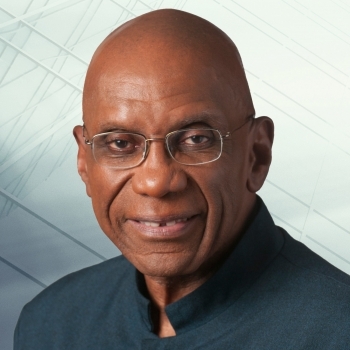
This weekly newsletter is put together by DeLisle Worrell, President of the ABCF. Visit us at Association for Barbados China Friendship | (abcf-bb.com).
I include news of the association and our members, as well as interesting items of news and a variety of commentary that you might not find elsewhere.
Thanks to everyone who sent contributions for this week’s Update. Please send items of interest to me via the contact page at ABCF-BB.com or to info@DeLisleWorrell.com
The ABCF mission is to build a deeper understanding between the Chinese people and Barbadians and Caribbean people from all walks of life. The association’s focus is on personal experiences, people-to-people contact, cultural exchanges and exchanges of ideas, and the facilitation of travel, business and study. From the outset we aim to learn from and build on the experiences of the Caribbean and China, and to develop mutual understandings and support that will be to the benefit of both sides.