Coming to China? These Are the Apps You NEED
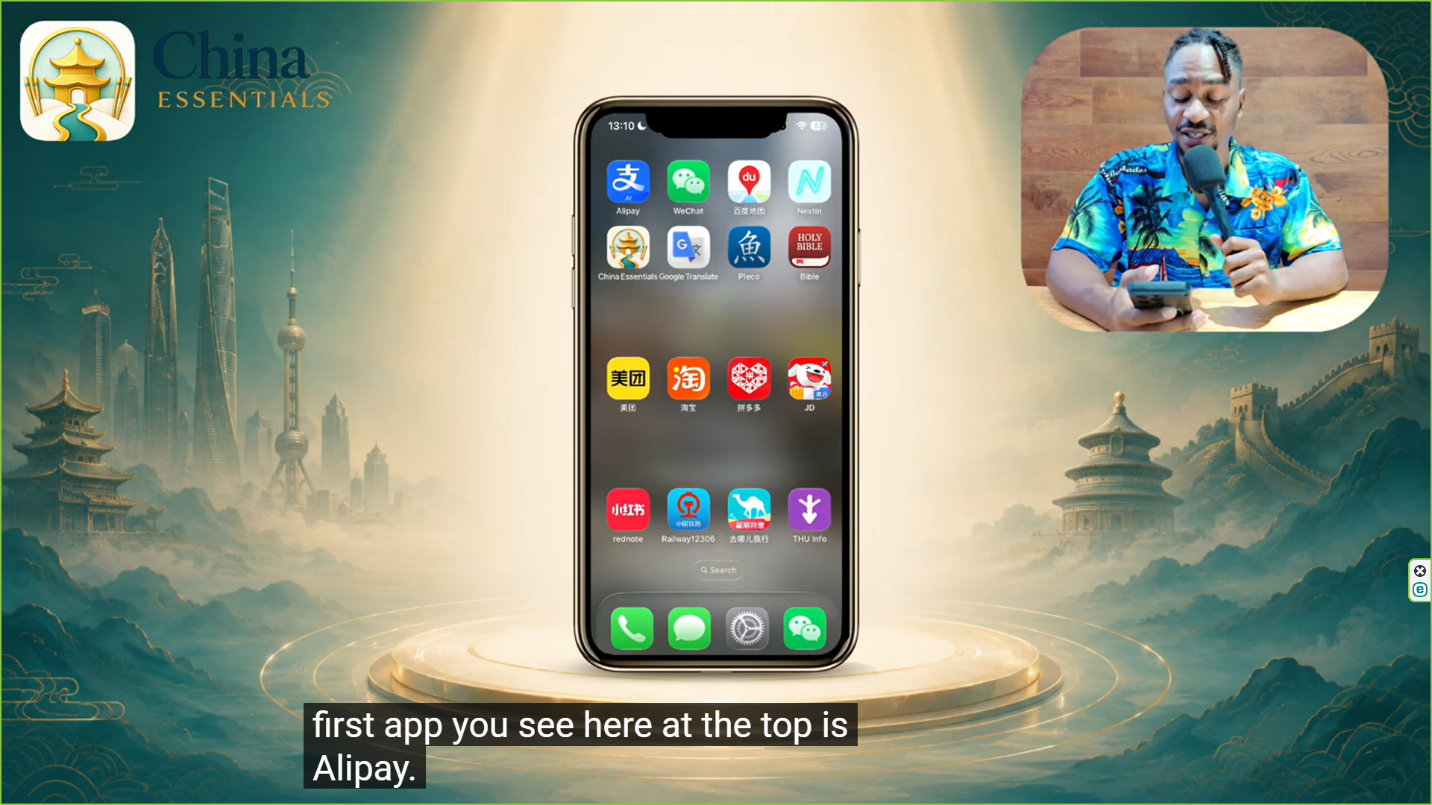
China Essentials is a community that involves an app and a YouTube page. The whole purpose of it is to make your life in China a whole lot easier. In this video I plan to go through all the apps that I use daily and all the apps that you would really need to survive in China. And in a quick way just kind of tell you what they're for and the main features. If you want to get more complete information for any of these apps you can follow and subscribe to this page. You can also check Instagram…
From Joshua Johnson, @chinaessentials
Big Tech Pulled the Plug. They Downloaded Their Lovers.
…On July 28, Business Alter (知危), a Hangzhou-based independent Chinese media outlet covering technology, Chinese companies’ overseas expansion, emerging consumer trends and new energy, published an article on WeChat about users who had downloaded their cyber “lovers” from different AI platforms before the shutdown.
The article offers a window into how deeply AI has entered the fabric of Chinese society, extending into people’s emotional lives and intimate relationships. It also captures users’ evolving attitudes toward AI companions in China, one of the world’s largest and most active markets for consumer-facing AI applications.
Drawing Between Worlds: Asian American Graphic Memoirs and the Search for Belonging
March 12 | 10:00 - 11:00 AM ET
Virtual on Zoom
On August 12, join the US-China Education Trust and the 1882 Foundation for a virtual discussion featuring graphic authors Ruth Chan, Leise Hook, Kathy MacLeod, and Malaka Gharib. Part of USCET’s Asian American Authors Series, the event will explore how graphic memoirs combine words and images to illuminate experiences of identity, migration, family, memory, and belonging.
Through this conversation, the authors will reflect on their creative processes, the relationship between illustration and written narrative, and the ways visual storytelling can challenge stereotypes and give form to experiences that are difficult to express through words alone.
This webinar will highlight their recent works, including Chan’s Uprooted, which recounts her move from Toronto to Hong Kong as a teenager; Hook’s Names and Faces, which examines the cultural “in-betweenness” she felt growing up with a Chinese mother and white American father; MacLeod’s Continental Drifter, which recounts her time as a Thai-American girl navigating between Bangkok and coastal Maine; and Gharib’s I Was Their American Dream and It Won’t Always Be Like This, which explore her experiences as a first-generation Filipino Egyptian American.
Join us online from 10:00 am to 11:00 am ET for this program, which will include a moderated conversation followed by audience Q&A.
Zhao Shukai: How China Allowed Private Employment
China’s removal of restrictions on private employment was gradual and contested. It unfolded through local experiments involving farmers, fishponds, and small workshops, amid conflicting instructions from senior leaders and repeated decisions to defer a definitive answer.
At the centre of the debate was a deceptively simple question: how many workers could a private individual employ before becoming a capitalist exploiter? Some officials cited a numerical example in Karl Marx’s Capital that later came to be treated as an eight-worker threshold. Others argued that policy should respond to the realities of rural production rather than abstract formulas.
Deng Xiaoping favoured allowing the practice to develop, observing its effects, and avoiding either immediate endorsement or suppression. The outcome, however, was not simply the result of Deng overruling ideological opposition. Senior leaders remained divided, local officials defended experiments already under way, and policy researchers exercised considerable influence by deciding which disputes appeared in central documents—and which were left unresolved.
Zhou Xiaoming: China’s exports feed the Global South’s industrial engines
China is not shipping goods to outcompete Global South producers; it is shipping the building blocks that make factories viable. According to an Oxford Economics report, nearly half of China’s total exports are intermediate goods – components and raw materials that feed into other countries’ production lines rather than finished products for consumers.
Take Southeast Asia. Customs data from the first half of 2026 shows China’s intermediate goods exports to Association of Southeast Asian Nations member states rocketed 24.5 per cent year on year to 2.86 trillion yuan. These kinds of inputs help Vietnamese electronics assemblers, Thai auto-part makers and Malaysian chip packagers produce and export their own finished goods. This is deep integration – China supplying the “organs”, Asean flexing the “muscles.”…
Zichen Wang: Beijing’s message to the world’s tourists — come here and judge China for yourselves
…Walk through central Beijing today and one thing quickly becomes apparent: foreigners are back. They are taking photos outside the Forbidden City and sitting in cafes around Gulou and Sanlitun. The shift is visible online, too; YouTube is increasingly filled with videos titled “China Shocked Me” or “My First Week in China”. Most of the creators are tourists, not China specialists or journalists, and many of them are encountering the country for the first time….
Driving the change is one of the most consequential shifts in China’s external engagement in years: an expanded and upgraded policy for travelling without a visa. From 2023, Beijing started to grant 30-day visa-free entry to ordinary passport holders from 50 countries, including every G7 member except the US, and 25 of the EU’s 27 member states. Its 240-hour visa-free transit policy also now allows eligible travellers from 55 countries, including the US, to spend up to 10 days in large parts of China while travelling onwards to a third destination….
China looks beyond bricks and mortar, bets on people
The appearance of a supermarket founder at Premier Li Qiang's latest economic symposium offered a clue to how Chinese policymakers are thinking about the country's next engine of growth.
Among the business leaders invited to Premier Li Qiang’s latest economic symposium, one participant stood out: Yu Donglai, founder of supermarket chain Pangdonglai.
Known for its customer service and employee-focused management, Pangdonglai has grown into one of China’s best-known retail brands. The company employs more than 10,000 people and generates annual sales exceeding 20 billion yuan (about 2.8 billion U.S. dollars).
Zhang Ming: A Chinese model for currency internationalisation is taking shape
The dollar’s rise has long suggested a familiar path to currency internationalisation: run trade deficits, supply the world with liquidity and draw the money back through deep financial markets.
Zhang Ming, Deputy Director of the Institute of World Economics and Politics, Chinese Academy of Social Sciences (CASS), and Deputy Director of the National Institution for Finance and Development, suggests that China is pursuing a different model, one rooted in the strength of its manufacturing sector rather than the dominance of its financial markets. That strength could allow China to sustain current-account surpluses even as Chinese companies, banks and investors send more capital abroad. Supplying renminbi through financial-account outflows and drawing it back through current-account surpluses, he argues, is emerging as a distinctively Chinese path to currency internationalisation.
…Here, Meredith Chen looks at how tensions and shrinking academic exchange may be eroding America’s deep, experience-based understanding of China.
Long before China could be studied through satellite images, social media, big data or computer modelling, American scholars learned about the country the slow way.
Many travelled to the country. Some went far beyond its major cities, reaching remote county towns and villages by train, bus and boat to conduct fieldwork…
Leading Russian chemist and materials scientist Artem Oganov, who received China’s top international science and technology award, said the honour from the world’s No 1 science power was a sign he was “on the right track”.
Oganov, a distinguished professor at the Skolkovo Institute of Science and Technology in Moscow and long-time China collaborator, and eight other experts were awarded the International Science and Technology Cooperation Award by Chinese President Xi Jinping during a ceremony in Beijing last week.
After Oganov visited China in 2008, he told colleagues and friends in Europe that the country was “on the way” to being No 1 in both industry and science, but said this was met with scepticism at the time.
This weekly newsletter is put together by DeLisle Worrell, President of the ABCF. Visit us at Association for Barbados China Friendship | (abcf-bb.com).
Thanks to everyone who sent contributions for this week’s Update. Please send items of interest to me via the contact page at ABCF-BB.com or to info@DeLisleWorrell.com
The ABCF mission is to build a deeper understanding between the Chinese people and Barbadians and Caribbean people from all walks of life. The association’s focus is on personal experiences, people-to-people contact, cultural exchanges and exchanges of ideas, and the facilitation of travel, business and study. From the outset we aim to learn from and build on the experiences of the Caribbean and China, and to develop mutual understandings and support that will be to the benefit of both sides.