

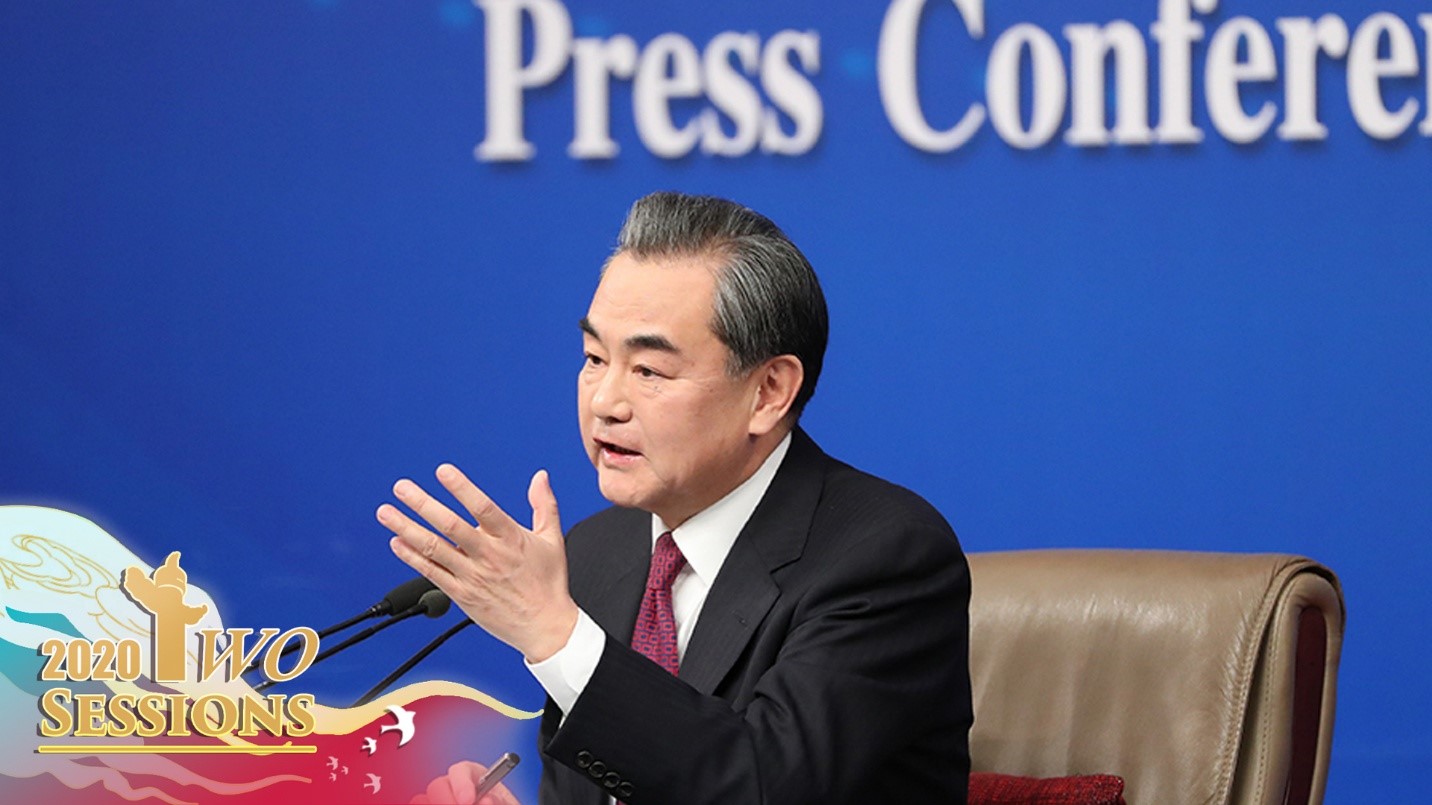
China’s top diplomat has cast his country as “an irreplaceable mainstay” amid global upheaval, rejecting any suggestion of a US-China G2 duopoly for global co-leadership as a replay of disastrous great-power rivalries.
Instead, against the backdrop of the escalating Iran conflict and Washington’s renewed trade wars, Wang Yi renewed Beijing’s call for a post-hegemonic order anchored in the United Nations, advocating an “equal and orderly multipolar world” that transcended bloc confrontation and spheres of influence.
Throughout the 90-minute meticulously choreographed press conference on the sidelines of the National People’s Congress, Wang presented China as a stabilising counterweight to the US amid accelerating “changes unseen in a century” – changes in which transformation and instability intertwined with ongoing conflicts.
China’s ‘two sessions’ 2026: everything you need to know | South China Morning Post
From US ties post-Iran to new tech innovation strategies, here is everything you need to know about China’s ‘two sessions’.
Local Interview: "Nail Houses" in Shanghai's Old City
You’ve heard of Chinese “nail houses” - those local residents whose unwillingness to sell their property block the aspirations of real estate developers, highway builders, and city planners. Contrary to much popular imagination, Chinese property (and land) owners enjoy fairly robust legal property protections and it can be quite difficult to dislodge a resident who is determined to not leave.
The most famous stories are often in rural areas, where standalone nail houses are striking and obvious, requiring highways or railways to make awkward detours to avoid the holdout property. But anyone could become a holdout, including someone in an apartment in the Shanghai old city.
A top Chinese political adviser has sounded the alarm on forced marriages of women with mental disabilities in rural areas, calling for a prevention mechanism and a nationwide investigation campaign.
Jiang Shengnan, a writer and member of the Chinese People’s Political Consultative Conference, China’s top political advisory body, warned that tackling the issue presented multiple challenges.
There was a lack of support for such women when it came to marriage-related decision-making, Jiang told state-run China News Service on Tuesday, ahead of the “two sessions” – China’s annual top legislative and advisory meetings.
Yao Yang: the post-2018 evolution in China's political economy
In his remarks, Yao argued that China’s reform and opening era effectively ended around 2018, ushering in what he described as a “new era.” He examined the leadership’s attempts to correct perceived excesses of the reform period while reorienting national resources toward manufacturing strength and technological self-reliance—an economic strategy that he linked to China’s broader strategic objectives, including reunification with Taiwan.
China has passed a new law on ethnic unity, creating a legal framework that analysts say is designed to counter Western ideological influence and provide a statutory mandate for assimilating the country’s minority groups.
The Law on Promoting Ethnic Unity and Progress was formally endorsed by the National People’s Congress (NPC), China’s top legislature, at the end of the annual “two sessions” on Thursday.
The law was adopted by a near-unanimous vote of 2,756 in favour, with just three against and three abstentions
China Taxicab Chronicles 9: Mrs. Mi Will Buy a House in Kashgar
I'm heading to a meeting in Pudong (the other side of the river in Shanghai). Mrs. Mi picks me up in a new GAC Aion Y and confirms my phone number.
Her Chinese accent sounds like mine in Chinese class 15 years ago. Mandarin is clearly not her first language.
"You...you're not Chinese, right?" she asks.
"No, I'm American. Do I look Chinese?"
"You look Arabic, or like you’re from Afghanistan. But you sound Chinese"
"I've been here a long time"
"How long?"
"13 years"
"Oh, longer than me"
"How long have you been in Shanghai?"
"Over one year"
"Ah, welcome to Shanghai. I can hear your accent...you're from Xinjiang right? What part?"
"Yes. I'm from Kashgar"
China passes Ecological and Environmental Code
The Code was adopted by a high vote at the Fourth Session of the 14th National People’s Congress on March 12, and will come into force on August 15, 2026.
China currently has more than 30 effective laws, over 100 administrative regulations, and more than 1,000 local regulations related to ecological and environmental protection. The Code integrated scattered environmental protection legal norms and consolidate the legal foundation for ecological protection. It not only improves the legal system but also perpetuates the experiences of ecological civilization construction in the form of a Code, providing long-term and stable legal guarantees for the construction of ecological civilization.
Investing in people, in Rmb20 instalments - by Zichen Wang
This has been the deeper pattern of Chinese governance for years. The state is perfectly capable of spending vast sums when the spending is concrete, visible, and easier to discipline from above. It can build hospitals, fund anti-poverty campaigns, and mobilise whole bureaucracies to eradicate extreme deprivation. In 2021 the government declared complete victory in the campaign against extreme poverty, saying nearly 100 million rural poor had been lifted above the official threshold. It can also subsidise consumption when that consumption is tethered to production goals: this year’s work report boasted that the expanded trade-in programme for appliances and other goods had helped generate more than Rmb2.6trn in sales. Beijing is not allergic to spending. It is just not confident about spending that gives households too much autonomy over how to use the money.
That is why the debate over rural pensions matters so much. It exposes the narrowness of the Chinese state’s redistributive imagination. For years, “common prosperity” was hyped abroad as if China were preparing some sweeping socialist levelling project. In practice, the state has remained extraordinarily cautious about direct transfers to ordinary people. It will subsidise a refrigerator, an electric car, or a washing machine. It is much less comfortable simply giving a poor old villager enough cash to buy meat, medicine, or a thicker coat, and trusting them to decide the rest. The result is that one of the most loudly advertised slogans rings increasingly hollow. A society cannot convincingly claim “common prosperity” while asking elderly farmers to live on Rmb163 a month.
Reminder: free Mandarin tutorials available
The ABCF is offering free tutorials, in association with the Barbados-China Returned Students Association, to tutor Barbadian and other Caribbean students up to the level of proficiency in Mandarin that is required to qualify for scholarships offered by the Chinese government, provinces and universities. Our program also includes promotion of opportunities to study in China, support for the university and scholarship application process, support for students studying in China, and information on career prospects for graduates. To apply, please contact us at by WhatsApp at +1 (246) 288-1356 or by email.
This weekly newsletter is put together by DeLisle Worrell, President of the ABCF. Visit us at Association for Barbados China Friendship | (abcf-bb.com).
Thanks to everyone who sent contributions for this week’s Update. Please send items of interest to me via the contact page at ABCF-BB.com or to info@DeLisleWorrell.com
The ABCF mission is to build a deeper understanding between the Chinese people and Barbadians and Caribbean people from all walks of life. The association’s focus is on personal experiences, people-to-people contact, cultural exchanges and exchanges of ideas, and the facilitation of travel, business and study. From the outset we aim to learn from and build on the experiences of the Caribbean and China, and to develop mutual understandings and support that will be to the benefit of both sides.