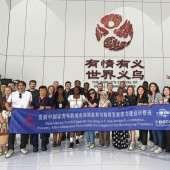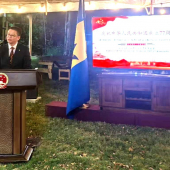
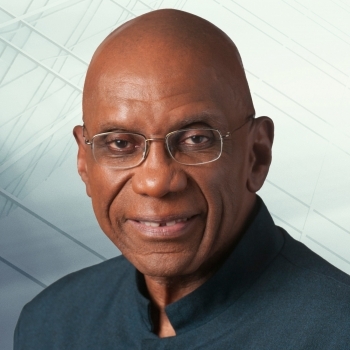
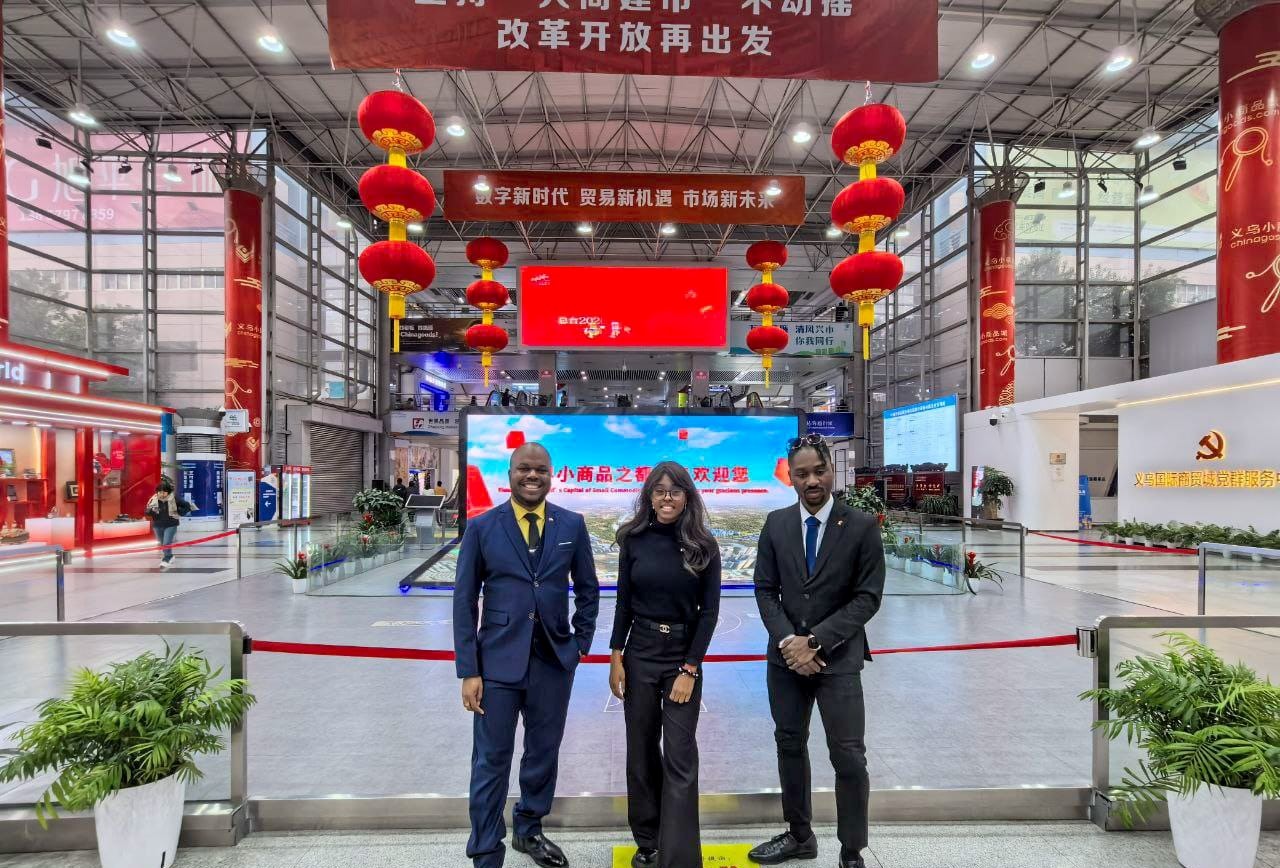
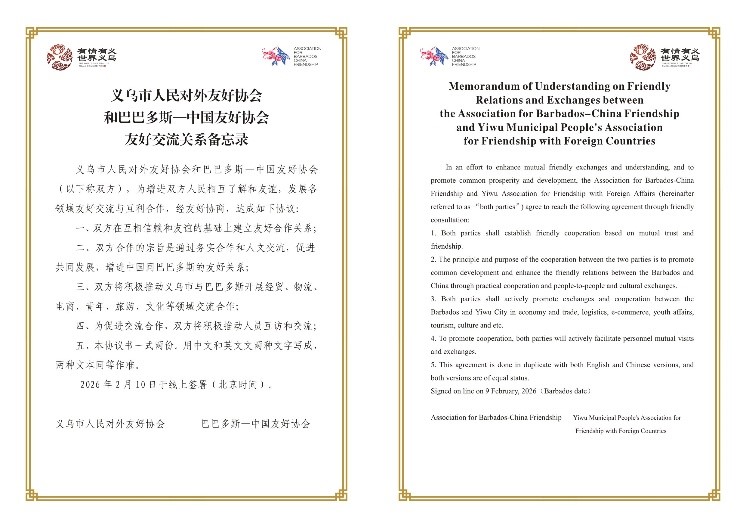
At a webinar held in the evening of February 9, 2026 (the morning of February 10 in China) the President of the ABCF, Dr DeLisle Worrell, signed a Memorandum of Understanding with Mr. ZHANG Jianmin, Director of the Secretariat of the Yiwu Municipal People’s Association for Friendship with Foreign Countries, providing for exchanges and cooperation between Barbados and Yiwu City in trade and commerce, logistics, e-commerce, youth affairs, tourism, and culture. In addition, the friendship associations will facilitate mutual visits and exchanges between Barbados and China. In preparation for the signing, a small ABCF delegation visited Yiwu City in January; videos from their visit may be found at this link, and this.
If you are involved in any way in commerce with China or are considering trading with China, we invite you to write to us at ABCF-BB Association or at the ABCF WhatsApp number, +1 (246) 288-1356 indicating your name, the name of your company, your email, your phone, and the kind of business in which you are engaged, so that we may inform you of follow-up activities which are planned to follow up on the opportunities which this initiative may provide.
Reminder: free Mandarin tutorials available
The ABCF is offering free tutorials, in association with the Barbados-China Returned Students Association, to tutor Barbadian and other Caribbean students up to the level of proficiency in Mandarin that is required to qualify for scholarships offered by the Chinese government, provinces and universities. Our program also includes promotion of opportunities to study in China, support for the university and scholarship application process, support for students studying in China, and information on career prospects for graduates. To apply, please contact us at by WhatsApp at +1 (246) 288-1356 or by email.
China’s central bank set the yuan’s daily fixing rate at its strongest level since mid-2023 on Wednesday, as the Chinese currency extended gains with investors increasingly rotating out of US dollar assets amid concerns over the Federal Reserve’s independence and US debt sustainability.
The People’s Bank of China set the yuan’s midpoint rate – also known as the daily fixing rate – at 6.9438 to the US dollar, which marked the strongest level in 33 months.
The move followed months of steady appreciation in the yuan, with its offshore rate trading at 6.909 per US dollar as of early afternoon on Wednesday.
A very Chinese time? How memes are paving the way for a soft power shift | South China Morning Post
Drinking hot water, eating warm congee and dressing in red to pray for good luck are daily rituals shared by social media users across the globe who have embraced a new lifestyle trend, declaring: “You met me at a very Chinese time in my life.”
The phrase has been popularised over the past year by influencers on TikTok and Instagram who post themselves performing stereotypically Chinese activities.
The trend reflects a positive shift in how China, or “Chineseness”, is perceived globally.
A 30-year-old Chinese woman earning over 1 million yuan (US$140,000) per month has publicly announced her retirement plans to travel to Iceland, igniting widespread envy among younger generations online.
Deng Yiran, a geophysics graduate from Nanjing University in Jiangsu province, southeastern China, has garnered considerable attention following her announcement to retire at such a young age.
As of this month, Deng collaborates with several companies across China, including those in Beijing, Liaoning, Zhejiang, and Fujian province, holding executive positions in six of them.
Transcript: China’s propaganda machine? The controversies and reality around the Confucius Institute
From 2019 to 2025, Michael Jinghan ZENG was Professor of China and International Studies at Lancaster University and Director of Lancaster’s Confucius Institute, leading a team of nearly 30 staff. His work once sat at the centre of a widening debate in global higher education over language teaching, cultural influence, and the governance of academic exchange.
Now a professor in the Department of Public and International Affairs at City University of Hong Kong, he has published Memoirs of a Confucius Institute Director, Volume 1: Challenges, Controversies, and Realities, an unprecedented personal account written in the wake of that period of scrutiny.
Why U.S.–China Relations Matter to the Heartland
USHCA is proud to share the latest installment of Why U.S.–China Relations Matter to the Heartland, a state-by-state resource highlighting the economic, educational, and cultural ties between Heartland states and China—all in one easy-to-access platform.
Developed over the course of 2025 and released late last year, this edition draws on publicly available data accessible during that period. Designed for business leaders, policymakers, higher education professionals, and the public, the report provides updated insights on exports, trade impacts, education ties, and sister-city partnerships.
In a time of heightened uncertainty and challenge in the U.S.–China relationship, the 2025 report serves as both a retrospective on recent years and a clear marker of what is at stake for the Heartland moving forward.
Monopoly without market, subsidies without subscribers: Guo Quanzhong on state media
Guo has launched a brisk WeChat series skewering the transformation of China’s mainstream outlets—state-owned newspapers and broadcasters under various tiers of government—which, for all their privileges in licences and fiscal subsidies, command scant loyalty. Meanwhile, platforms such as WeChat, Weibo, and Douyin have become the country’s most popular and lucrative purveyors of information.
The culprit, he argues, is both institutional constraint and the internet’s steady gravitational pull. Audiences have migrated to platforms; the platforms, not news outlets, own the users’ loyalty. Advertising, in turn, follows distribution rather than reportage.
He also punctures a cherished newsroom conceit: content is a necessity, but news is not. News is a narrow, perishable slice of content, whereas entertainment, knowledge, and services are what he believes win wallets. Add overstaffed newsrooms, thin reporting, and low technical capacity, and the mainstream media’s business model collapses.
Asian Immigration to the United States in Historical Perspective - American Economic Association
Asian Americans are the fastest-growing immigrant group in the United States, yet Asian immigration remains relatively understudied in quantitative social science. This paper reviews the historical evolution of Asian immigration, focusing on six major origin countries—China, Japan, India, the Philippines, Korea, and Vietnam—to show how US immigration and foreign policy shaped the size and composition of immigrant arrivals. It then examines subsequent patterns of demographic composition, geographic settlement, and socioeconomic characteristics. Taken together, the evidence highlights the enduring influence of US policy regimes on Asian immigration over time.
From Asia, with Skills - American Economic Association
This paper examines the rise of high-skill migration from Asia to the United States since 1990 and its consequences for sending and receiving economies. Over 1990–2019, migrants from India, China, South Korea, Japan, and the Philippines accounted for over one-third of US growth in software developers and a quarter of the increase in scientists, engineers, and physicians. Using census microdata, visa records, and administrative sources, I show how growing US demand for talent in information technology, higher education, and healthcare interacted with Asia's demographic and educational transformations. Policy reforms in the H-1B, F-1, and J-1 programs and sectoral shifts—such as the internet revolution and aging-related healthcare demand—generated persistent needs for foreign students and workers. Asian economies were uniquely positioned to meet this demand through tertiary expansion, strong STEM institutions, English proficiency, and diaspora networks. These inflows boosted US innovation while fostering "brain gain" and "brain circulation" in Asia.
Over 10 million students graduate from Chinese universities every year, straining an already crowded labour market. Yet the “micro drama” industry is emerging as a crucial lifeline for hundreds of thousands of young jobseekers: offering the chance to turn creativity into a stable pay cheque.
The sector was estimated to directly generate about 690,000 jobs in 2025 – mostly for young people – and over 2 million positions when counting upstream and downstream roles, according to a recent report by Peking University’s National School of Development.
The emerging industry – whose dramas run just a few minutes per episode, with fast-paced storylines and frequent twists meant to capture eyeballs – has relatively low entry barriers and sustainable opportunities, particularly important given chronically high youth unemployment, the report’s authors said.
This weekly newsletter is put together by DeLisle Worrell, President of the ABCF. Visit us at Association for Barbados China Friendship | (abcf-bb.com).
Thanks to everyone who sent contributions for this week’s Update. Please send items of interest to me via the contact page at ABCF-BB.com or to info@DeLisleWorrell.com
The ABCF mission is to build a deeper understanding between the Chinese people and Barbadians and Caribbean people from all walks of life. The association’s focus is on personal experiences, people-to-people contact, cultural exchanges and exchanges of ideas, and the facilitation of travel, business and study. From the outset we aim to learn from and build on the experiences of the Caribbean and China, and to develop mutual understandings and support that will be to the benefit of both sides.