
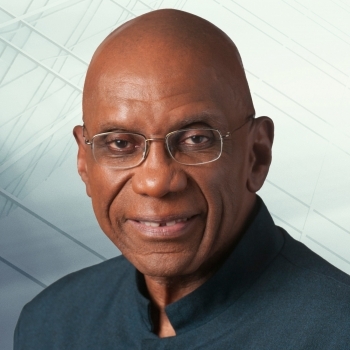
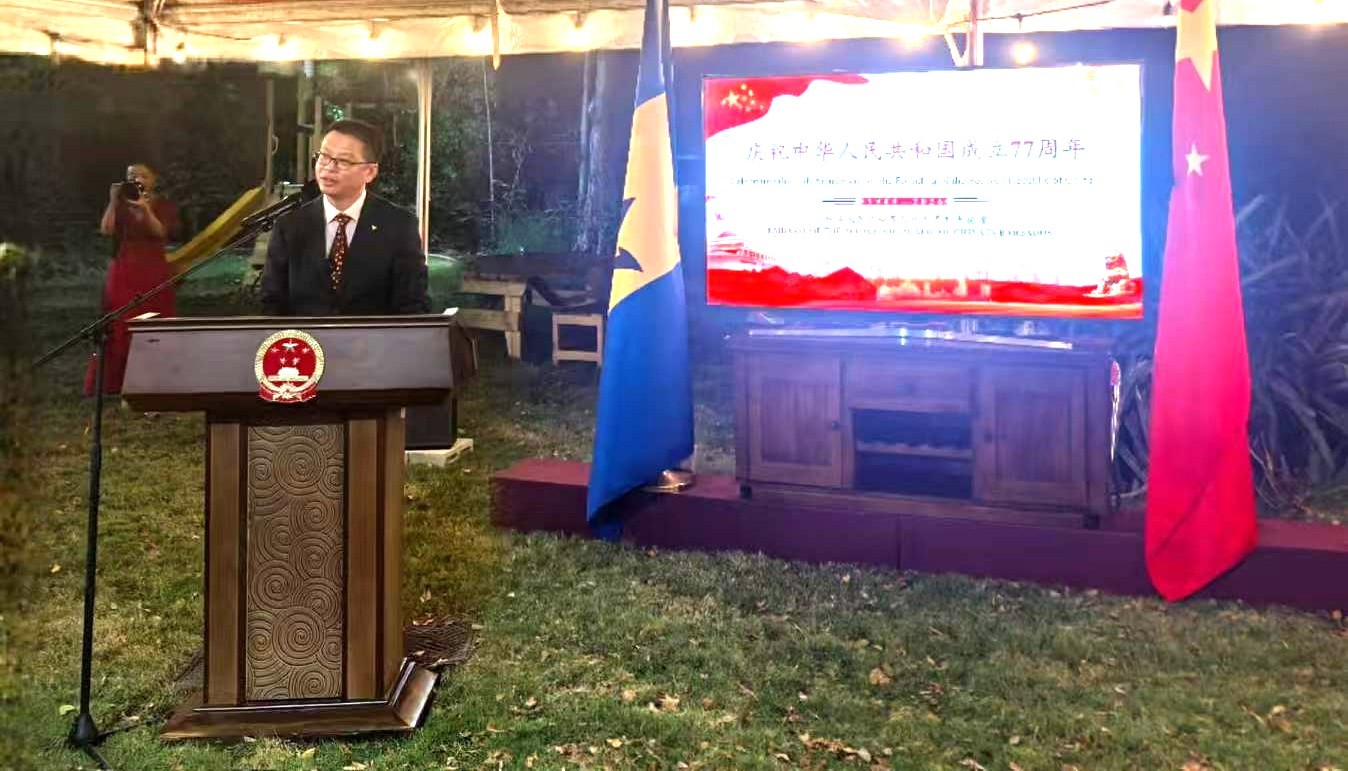
The 77th anniversary of the foundation of the People’s Republic of China was celebrates a few days early in Barbados with an elegantly formal reception on the lawns of the Chinese ambassador’s residence. Addresses were given by Counsellor CHEN Chen, Chargé d’Affaires at the Chinese embassy and Hon. Chris Sinkler, Senior Minister of Foreign Affairs, and guests were treated to a delicious buffet dinner which included moon cakes, traditional delicacies prepared for Chinese festivals.
There were celebrations all across China nd in Chinese embassies round the world on October 1, the actual day of the anniversary.
People celebrate 77th founding anniversary of PRC in China-Xinhua
People attend a flag-raising ceremony marking the 77th anniversary of the founding of the People's Republic of China at Wuyi Square in Fuzhou, southeast China's Fujian Province, Oct. 1, 2026. People celebrated the 77th anniversary of the founding of the People's Republic of China in various ways on Thursday.
The Confidence Machine - by David Fishman
[This is] not my typical fare. It’s not about energy, or electricity, or Chinese travel, or taxi interviews. It’s about the Chinese property market and consumer confidence. But I’ll try to make it interesting nonetheless.
A two-part series. This is Part 1: The Confidence Machine
… A Chinese consumer’s decision tree could perhaps go something like this:
Do I have money?
Yes.
But is consumption the best use of this money?
And will I still feel secure if I spend this money?
And will I still feel secure if my assets stop appreciating?
Okay, maybe I’ll wait.
This is also a caricature of course. But effective caricatures work because they contain a recognizable truth. The American caricature treats consumption as the preferred destination of income. The willingness to consume can almost be assumed by default. By contrast, the Chinese caricature is more likely to ask whether consumption is the best use of the money, and whether spending it today will leave them feeling secure tomorrow. Even where capacity exists, willingness cannot be assumed.
… Property wealth was the principal channel through which Chinese households generated consumption confidence. When the market turned, the confidence machine turned with it. Existing homeowners felt poorer and consumed more cautiously. Households still looking to buy their first urban property became more inclined to wait, and also didn’t consume. With the attractiveness of the property allocation channel so degraded and still no good reason to consume, an awful lot of yuan that used to go directly into property - or into deposits and then property, is now stuck in deposit limbo. Tens of trillions of it.
How Far Can the Debate over “One Country, Two Systems” Go?
His answer is built around reciprocity. Taiwan, in his framework, would accept unified sovereignty, rule out de jure separation and foreign military intervention, undertake national-security obligations and accept limits on its autonomous powers. Beijing, in return, would have to convert “Two Systems” from a political promise into enforceable constitutional commitments: protecting elections, judicial authority, basic rights, fiscal and economic autonomy and, during a transition, elements of local defence, while making those guarantees difficult for the central authorities to diminish unilaterally. His central formula is succinct: Taiwan’s autonomy must not hollow out “One Country,” but sovereignty must not erase “Two Systems.”
Gan Yang 1980s Interview 4 - Reading the China Dream
This part of the interview discusses Gan Yang’s life and work as the editor of his famous translation series “Culture: China and the World.” More broadly, Zha and Gan are talking about a period known as the “culture craze” wenhuare/文化热, when Chinese intellectuals once again looked to the West for answers to the problems China was facing, much as they had done in the 1920s during the New Culture Movement. Gan was definitely a major player in this movement, and he and Zha discuss many other participants in the culture craze.
I particularly appreciate Gan’s frankness in this section of the interview. He is old enough that he can laugh at his younger self for his arrogance and pretentiousness, even though he still believes that he and his friends did something important (a belief I share). From one perspective, Gan is still the “punk” he was as a sent-down youth, throwing his intellectual weight around to try to get to the top. At the same time, he and his band of “snobs” (their words, from the interview) have the souls of sensitive poets, and much of their inspiration comes from German Romanticism.
China fires policy salvo: first-ever mortgage subsidies, PSL rate cut, relending boost
China has rolled out a fresh package of fiscal and monetary measures covering housing, infrastructure, technological upgrading and small businesses, sending a strong policy signal that authorities are stepping up targeted support to spur domestic demand and boost economic growth.
Diao Daming: the costs of studying China at a distance
Diao Daming, Professor at the School of International Studies and Chair of the Department of Diplomacy, Renmin University of China, appears deeply concerned that China studies in the U.S. is losing intellectual discipline at precisely the moment it matters most.
Where earlier scholars sought to understand China on its own terms, some younger researchers who came of age intellectually in the era of “strategic competition” approach it with “vigilance” rather than inquiry. Diao points to a rising cohort of researchers who rarely visit the country and possess little to no command of the language, history, or culture. In place of lived experiences and primary sources, they have substituted quantitative data and computer modelling, and are too often forcing China’s institutional realities into American political and economic templates. In a relationship already running on fragile trust, he cautions that this drift towards abstract, off-the-top-of-the-head analysis is not merely regrettable, but “crisis-inducing”.
Why Every China Watcher Must Be on WeChat - by Zichen Wang
WeChat (微信 Weixin) is not just another messaging app in China – it’s essentially “the operating system for daily life” in the country. With over 1.3 billion users worldwide (covering almost 80% of China’s population), WeChat has grown from a simple chat app into a ubiquitous “everything app.” In fact, it has become so deeply woven into Chinese society that businesses and individuals often ask for a WeChat ID instead of a phone number or email when exchanging contacts. For anyone involved in China news, research, or analysis, not using WeChat is a nearly insurmountable handicap in staying connected.
Li Xunlei on China’s Transport Overcapacity
Li argues that China’s transport infrastructure, including expressways, railways, and urban public transport, has already developed structural overcapacity: in less-developed regions, infrastructure expansion has often exceeded what local populations and economies can support, while the continued expansion of transport networks has been accompanied by lower utilisation, weaker investment returns, and heavier debt burdens. Demographic changes, declining population mobility, and greater population concentration in major cities are only going to widen these mismatches.
Off the Beaten Track: Will Travel for Food in Luotian County
When I first wrote about Chinese urbanization rates, I mentioned in that essay that my reason for visiting Luotian County, in Huanggang City, Hubei was to try a local culinary specialty.
That specialty is called Luotian “’Hanging Pot” (罗田吊锅). It was delicious and you should try it if you get a chance.
It’s a simple country dish - clear broth that gets most of its flavor from the protein base. Our pot also had cured pork and fish, carrot, potato, radish, chives, mushrooms, tofu... Bubble away for 20 mins so the broth is fragrant and flavorful. Add rice and vegetables and you’ve got a full meal.
This weekly newsletter is put together by DeLisle Worrell, President of the ABCF. Visit us at Association for Barbados China Friendship | (abcf-bb.com).
I include news of the association and our members, as well as interesting items of news and a variety of commentary that you might not find elsewhere.
Thanks to everyone who sent contributions for this week’s Update. Please send items of interest to me via the contact page at ABCF-BB.com or to info@DeLisleWorrell.com
The ABCF mission is to build a deeper understanding between the Chinese people and Barbadians and Caribbean people from all walks of life. The association’s focus is on personal experiences, people-to-people contact, cultural exchanges and exchanges of ideas, and the facilitation of travel, business and study. From the outset we aim to learn from and build on the experiences of the Caribbean and China, and to develop mutual understandings and support that will be to the benefit of both sides.